Courses taught
Product Management Practice
Product Management Practice is an industry-oriented course designed to build structured product leadership capability in an increasingly digital and AI-enabled marketplace.
The course moves systematically through the product lifecycle; beginning with market opportunity assessment and customer need-state analysis, and progressing through concept development, feature prioritization, value proposition design, and roadmap creation. Students learn to apply frameworks such as Jobs-to-be-Done, value proposition canvas, concept testing, and agile road-mapping in real-world contexts.
A strong emphasis is placed on execution. The course covers:
Product strategy and strategic choice
Feature prioritization and roadmap planning
Product marketing and go-to-market (GTM) strategy
Digital marketing analytics and AI-assisted marketing tools
Product launch tracking and early-warning systems
Brand and customer experience (CX) measurement
Students work on collaborative projects that simulate industry scenarios - analyzing markets, developing product concepts, building roadmaps, and designing measurement frameworks.
By integrating data-driven decision-making and the application of AI/Generative AI tools into product strategy and marketing workflows, the course prepares students to operate effectively in modern product environments - where structured thinking, customer insight, and technological fluency must coexist.
Generative AI - Business Applications
Generative AI – Business Applications is an elective course for MBA students, designed to move beyond experimentation and hype into structured managerial adoption of AI technologies.
The course begins by building conceptual clarity around the foundations of Artificial Intelligence and Generative AI - covering machine learning, deep learning, neural networks, transformers, and large language models.
The course then transitions into cross-functional application across core business domains such as Sales and Marketing, Operations, IT, HR etc. Through applied exercises and real-world examples, students analyze where Generative AI adds value, where it introduces risk, and how it alters existing business processes. The curriculum also cover key trends such as Agentic AI.
A key part of the is around AI risk management and responsible AI to clearly appreciate that technological capability must be balanced with accountability and human judgment.
The course culminates in a capstone project where students design and present a structured proposal for implementing Generative AI in a specific business context. This requires moving from tool usage to strategic thinking - defining the problem, assessing feasibility, managing risk, and articulating measurable business impact.
By the end of the course, students are equipped not merely to use AI tools, but to evaluate, design, and lead AI-enabled initiatives responsibly within modern enterprises.
My classes at Amrita School of Business
As an adjunct professor at Amrita School of Business (ASB), I am proud to be part of an institution ranked #7 among India’s Top Universities (NIRF). Within this elite academic ecosystem, ASB stands as a premier AACSB-accredited institution, consistently recognized among the top 30 management schools nationwide. My work here focuses on bridging global business standards with ethical, value-based leadership to develop the next generation of industry-ready professionals.
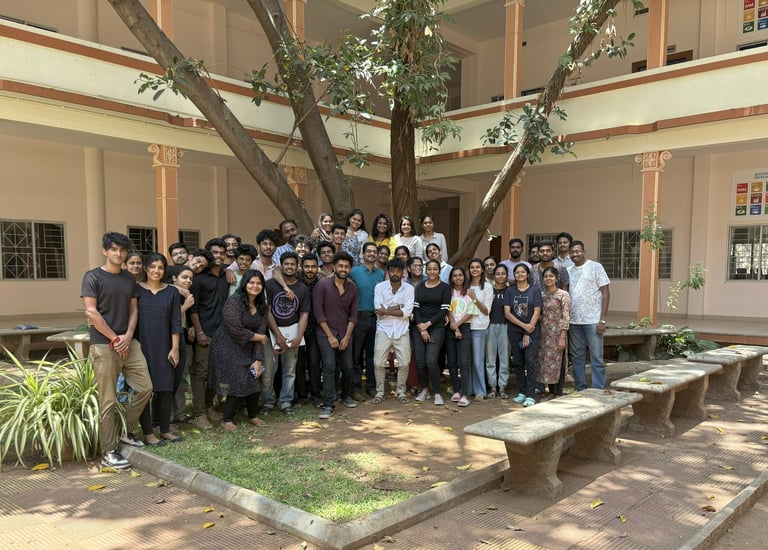

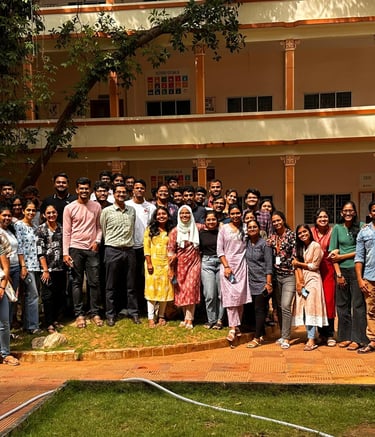
Product Management Practise
Class of 2026
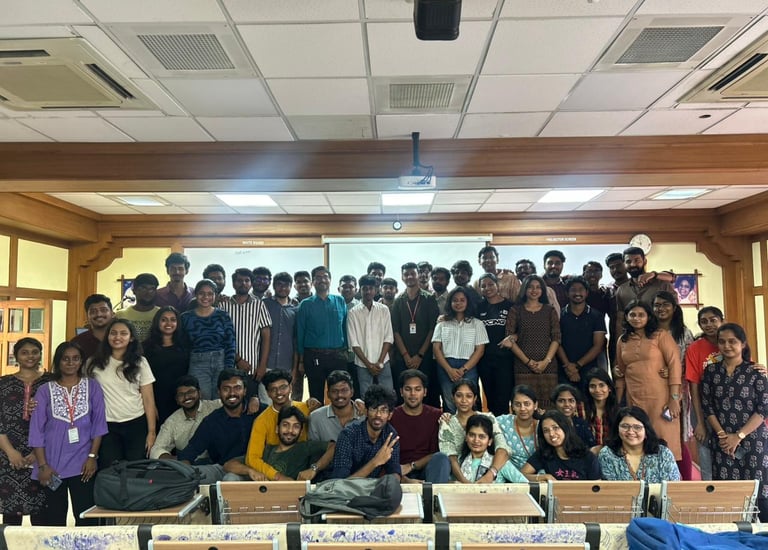
Generative AI Applications in Business
Class of 2024
Product Management Practise
Class of 2025
